
Some people aren’t going to like this but it’s a truth I feel strongly about. I learned from those who know and changed my ways. For goodness sake, please stop feeding wild animals.
It’s Dangerous
When I ate an apple in a car, I used to toss the core in the ditch, reasoning that it was natural and an animal might enjoy eating it. Or it would simply rot into the earth. It was something my mother did. Banana peels, pear cores, whatever remnants of fruit we had on board was handled this way.
Then Brian Salt of Salthaven Wildlife Rehabilitation and Education Centre explained that any kind of food near a road poses a danger to animals. It draws them closer to traffic and makes it more likely they’ll get hit by a vehicle. I don’t toss cores anymore.
There’s another danger in normalizing the animal-human relationship. It’s great when a deer doesn’t freak out at the sight of you but they should at least be wary. After all, some humans carry guns and their goal is to shoot first, ask questions later. I’d rather that an animal run away from me than have some illusion that all human are pals. Not everyone has kind intentions.
Visitors to animal reserves are told not to feed the critters but many do anyway. A man in Romania was recently attacked by a bear he stopped to feed despite being told not to. The bear shattered his car window and bit him while trying to drag him out of the vehicle. His seatbelt saved him. He’s lucky to be alive and the fool still says he did “nothing wrong.”
It’s Disruptive
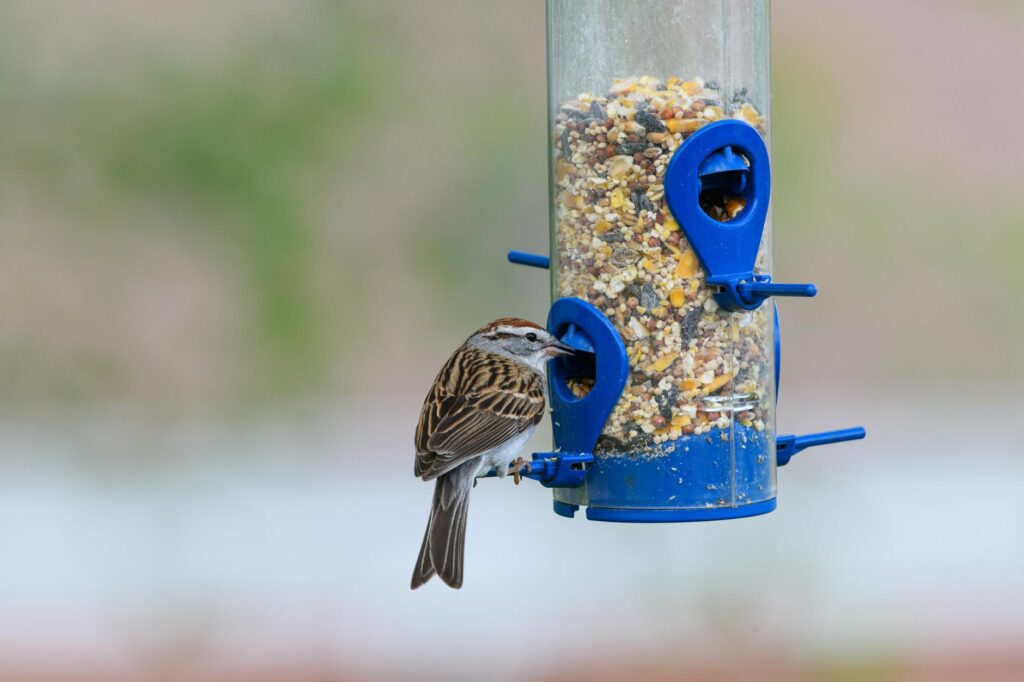
But we put out bird seed, you say. Yes, we do, because birds explore wide territories, thousands of kilometres, and seed supplements their diet when they need it. Sure, some greedy feathered friends will stay and gorge like it’s the free buffet at a work function. But storebought bird seed has been developed to mimic the bird’s natural diet. It’s not the same as putting out pasta leftovers for the neighbourhood possum.
Animals teach their babies how to forage. If they become dependent on an easy source from Madge’s back porch, and Madge moves away, they could starve. By using feeders, birds don’t associate food with humans the way other animals do. This keeps the bird/person relationship at feather’s length.
Leaving food outside can attract rats and mice. Except for dramatic circumstances, a person can’t always tell whether an animal is hungry. And if it’s physically malnourished or acting weird, it’s time to call an expert. In the Port Stanley area, that’s Fur-Ever Wildlife Rehabilitation. Colleen knows what to do, how to humanely trap, and where to take bothersome or sick animals.
It’s Arrogant
Unless there’s a dire circumstance like a forest fire where animals have been displaced – and even then, experts should be consulted – there is no reason to feed a non-pet that crosses your path. They forage and survive just fine during the other 364 days of the year. What makes a human think the animal needs their help? Because they don’t have a debit card and aren’t allowed in stores?
Under the guise of kindness, many people anthropomorphize animals and give them human qualities they just don’t possess. An animal isn’t approaching a human to get food because there’s a special bond. It’s not friendship. It does it because it’s easier than finding food of their own.
I’m going to borrow a line from a thirty year old movie, The Truth About Cats and Dogs. In it, a veterinarian played by Janeane Garofalo counsels a man who’s letting his cat lick him for hours at a time. I think it applies here to people who attribute human thinking to the animals they feed: “Repeat after me. Us. Them. Us. Them. Us…them…”
Lisa, as always, this is a great post with lots of good advice .
Look at the issues they are having in Toronto with the coyotes! People are feeding them, even though signs are posted, don’t feed the coyotes.
Developers and cities have taken away so much land, animals don’t know where to go anymore. So sad.
Thanks for sharing your wisdom.
Roberta
It’s the wisdom of people like Brian Salt who educated me about it..Thanks, Roberta. We have coyotes here too and people even feed the wild geese. We all know how that turns out!
I used to have a bird feeder in Mississauga because I loved to see the various birds. I stopped because it attracted rats not mice. Huge rats. Trapped 5 of them. Now my neighbour in our small town has put out a bird feeder. It is attracting mice. My dog is trying to catch them as the bird feeder is just outside the corner of our fenced yard. I installed an electronic pest control device to keep the critters away from the house.
My goodness! I think I’ll stick with my hummingbird feeder!
We also have a trailer in a conservation area. It is nice to watch the birds while sitting on the deck. We have had a large pileated woodpecker come to the feeder. Beautiful bird! That said doing so attracted mice and racoons to our site. We decided not to feed the birds because when it gets cold outside they want to come inside our trailer where it’s warmer. Currently a robin has built a nest in the corner of the slide out of our trailer. He is currently attacking our trailer because he is protecting his nest in our trailer. He was here first so we have to respect the nest!
We went through that with a robin in our gazebo! It was fun to watch the babies grow and fly.
We watched our daughter-in-law’s feeder attract rats and that put an end to that feeder in a hurry, as nice as it was. Here in the woods on a tiny Gulf Island, it’s tempting to try to befriend the deer who pass by or stand on alert on our dog walks, guarding their little ones, but of course you’re so right. Just today a neighbour said he put a carrot out for a deer, and the carrot was now gone. He has a good heart, this man (he gave me two freshly baked buns, too) but although it’s fine for me to return for more, you’ve more than made a great point about why our dear deer friends should not. Thanks for always having animals’ wellbeing at heart, Miss Lisa.
Do you think animals have souls?
Well, I think that if someone believes people have souls that should extend to animals.
I believe animals have souls. And not every person has one!